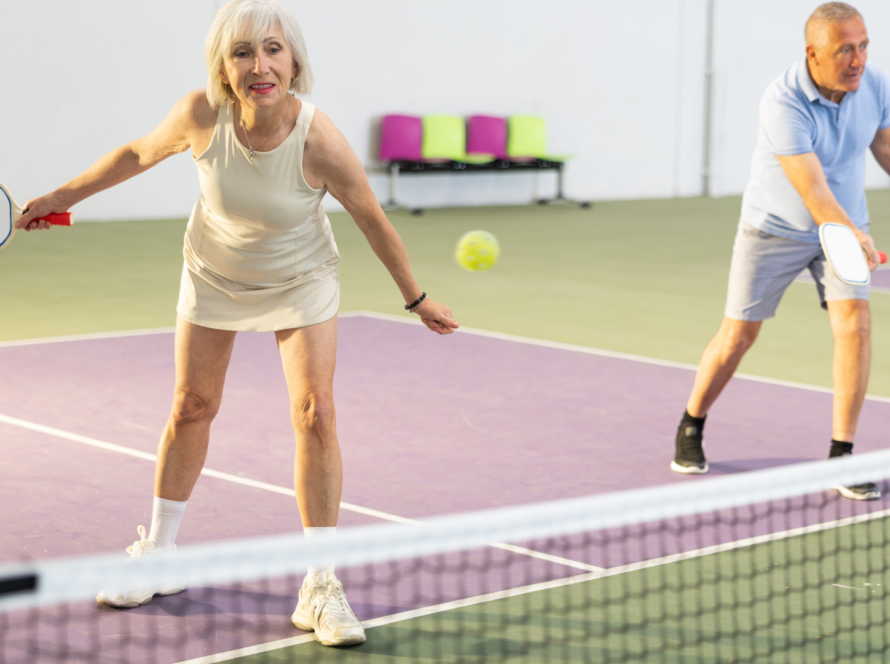
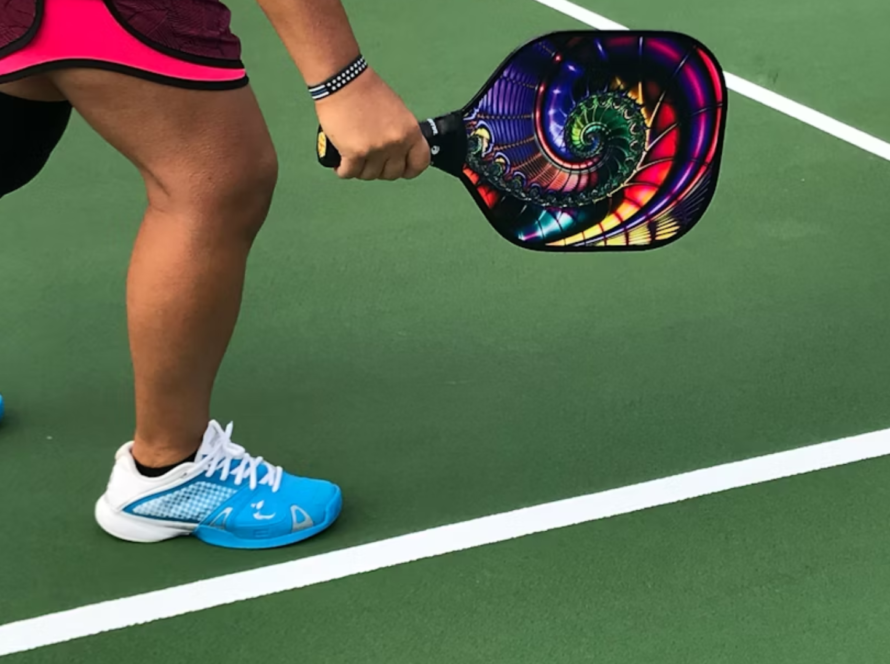
If you’re still playing pickleball in running shoes, this might be the easiest win you can grab without touching a drill. Pickleball’s stop-start rhythm, sharp C-cuts, and toe-drag volleys ask your shoes to do the opposite of what running shoes are built for. Runners roll you forward. Pickleball shoes hold you steady, let you swivel, and launch you in any direction.

Why “true” pickleball shoes matter
Pickleball shoes are engineered for multi-directional movement and court grip:
- Wide, flared sidewalls to resist ankle roll when you plant and cut
- Pivot discs or radial herringbone under the ball of your foot for smooth swivels
- Torsional support so your midfoot doesn’t twist when you split-step or recover
If you play more than once a week, proper court shoes aren’t a luxury—they’re protective gear that also makes you faster.
Top pickleball shoe models at Pickleball Central
You’ve got more options than you think. Here are standout models (with what they’re best at):
- ASICS Gel-Resolution 9 PB – Dynawall stability wrap + Rearfoot Gel. PB-specific outsole. Comes in D or 2E. Great for high arches and aggressive movers.
- Babolat Jet Mach 3 Pickleball – Matryx EVO Kevlar/PA woven upper. Among the lightest true PB shoes. Low 4 mm drop for nimble footwork.
- Wilson Rush Pro Ace Pickleball – 4D Support Chassis delivers torsional control; roomy toe box. Friendly for low arches and toe-draggers.
- Tyrol Striker Pro V – Built on a wider last (2E standard) with durable toe reinforcement. Popular with seniors and anyone wanting extra balance.
- New Balance 996v5 Hard-Court – FuelCell midsole for bouncy cushioning; great outdoor option with stable base. Available in wides.
- Diadora B.Icon AG Pickleball – Tour-level stability, DD Anima foam, toe wear-guards, and a 6‑month outsole warranty. A tank that still feels lively.
Models labeled “Hard-Court” are tennis-derived but chosen for outdoor pickleball’s gritty surfaces. If you split time indoors and outdoors, pick a hybrid outsole (details below).
Technology deep-dive (in plain English)
Upper materials (comfort + durability)
- Engineered Mesh (ASICS, HEAD, Wilson): Airy, flexible, breaks in quickly without feeling sloppy.
- Matryx Woven (Babolat): Kevlar-reinforced panels where laces and forefoot take a beating. Breathable and water-resistant.
- Clarino Microsuede (Tyrol): Resists peeling when you drag your big toe on low volleys or defensive scrambles.
Midsole compounds (cushion + rebound)
- DynaFoam (HEAD): Nitrogen-infused EVA that’s about 35% lighter than typical foams, reducing fatigue late in matches.
- FuelCell (New Balance): TPU/EVA blend with top-tier energy return—springy without feeling unstable.
- DD Anima (Diadora): Supercritical EVA that shines for shock absorption—great if your knees complain on concrete.
Outsole geometry (grip + glide)
- Full Herringbone: Excellent bite on painted concrete/asphalt. Think predictable traction outdoors.
- Omni-Court Hybrid: Larger radial pods under the forefoot plus herringbone at the heel (Babolat Jet Mach 3). Smooth pivots indoor and reliable grip outdoor.
- Pivot Disc: Concentric circles under the ball of your big toe (FILA Volley Zone, Wilson Ace) to reduce torsional shear during serve-and-volley step-offs and kitchen-line shuffles.
Indoor vs. outdoor rubber compounds
- Indoor courts (maple/PVC): Non-marking gum rubber (softer, Shore-A ~55) grips like crazy but wears fast on asphalt and can harden in cold.
- Outdoor courts (asphalt/concrete): Harder, carbon-blended rubber (Shore-A ~68–72) runs hotter but lasts ~3x longer on gritty surfaces.
If you play both environments, a hybrid outsole and outdoor-grade rubber give you the best “one-shoe” solution.
Fit & sizing cheat-sheet
Width tendencies:
- Standard (D): Skechers, HEAD, Wilson, Babolat
- Wide options: FILA, Tyrol (2E standard), New Balance 2E
- Narrow/contoured: ASICS Gel-Resolution PB, Diadora B.Icon
Arch profiles:
- Low arch / flat: Wilson Rush Pro Ace PB, Tyrol Striker Pro
- Neutral: K-Swiss Express 2, Skechers Viper 2.0
- High arch: ASICS Gel-Resolution 9 PB (removable Ortholite insole for custom orthotics)
Heel-to-toe drops:
- 4 mm: Babolat Jet Mach 3 PB (low, agile, better court feel)
- 7 mm: Skechers Viper 2.0 (balanced)
- 10 mm: K-Swiss Hypercourt Express 2 (classic, cushy heel)
Quick at-home width test:
- Remove the insole and stand on it. If your forefoot spills over more than ~4 mm either side, order Wide (2E).
Fit tips:
- Lock the heel with runner’s loop lacing (last eyelet) to reduce heel slip.
- If you use thick socks or orthotics, try a half size up or a model with a roomier toe box.
Match your shoe to your play style
Singles / power baseliners
- What to prioritize: Torsional rigidity and responsive midsoles for hard lateral pushes and quick recoveries.
- Try: HEAD Motion Pro, Diadora B.Icon, ASICS Gel-Resolution 9 PB.
Doubles net crashers
- What to prioritize: Lighter weight and a pronounced pivot circle for fast split-steps and kitchen-line pivots.
- Try: Babolat Jet Mach 3 Pickleball, FILA Volley Zone.
Seniors or joint-sensitive players
- What to prioritize: Shock-absorbing midsoles, wider base for balance, and extra heel crash pads.
- Try: Tyrol Striker Pro V, Skechers Viper Court Pro, New Balance 996v5.
Toe-draggers / ex‑tennis players
- What to prioritize: Reinforced toe wraps and durable forefoot rubber.
Care, maintenance & when to replace
- Rotate pairs: Alternate two pairs between sessions to let the foam rebound. Expect ~30% longer life.
- Know the wear point: When the herringbone ridges on the lateral forefoot flatten to about a coin’s thickness (~1 mm), your grip drops off fast—time to replace.
- Cleaning: Skip the washing machine. Use a soft brush with 3:1 water/vinegar, wipe salt and dust, and air-dry away from direct sun (UV shortens midsole life).
The cost–benefit that actually saves you money
- Average ER cost for a Grade II ankle sprain: about $1,450.
- Average upgrade from generic trainers to true pickleball shoes: $45–$60.
- Break-even: Avoid a single injury every two years and you’ve paid for a lifetime of shoe upgrades.
Buyer-friendly perks (brand-dependent and retailer-specific):
- 30‑day play-test guarantees (common with HEAD, Selkirk, Tyrol)
- 6‑month outsole warranties (select ASICS and Diadora models)
- Free size exchanges in the continental U.S. at many specialty retailers
Quick decision flow (60-second checklist)
- Where do you play most?
- Mostly outdoor: Choose outdoor rubber; full herringbone or hybrid outsole.
- Mostly indoor: Non-marking gum rubber, pivot-friendly forefoot.
- What’s your foot shape?
- Narrow/high arch: ASICS Gel-Resolution PB, Diadora B.Icon.
- Wide/flat: Tyrol Striker Pro V, Wilson Rush Pro Ace PB, New Balance wides.
- How do you play?
- Fast at the kitchen: Light with pivot disc (Babolat Jet Mach 3, FILA Volley Zone).
- Power from the back: Stable with torsion plates (HEAD Motion Pro, ASICS Gel-Res PB).
- Need durability for toe drags?
- Look for raised rubber toe wraps (Wilson Rush Pro Ace PB, Diadora B.Icon).
- Sensitive joints?
- Softer, shock-absorbing midsoles (DD Anima, FuelCell) and wider stance.
FAQ
Q1: Can I use volleyball shoes for indoor pickleball?
A: Yes—if they’re non-marking and you don’t need heavy toe protection. Just know many volleyball shoes sit taller, which some players find less stable during wide cuts.
Q2: Are BOA dials worth it?
A: If you want quick, micro-adjustable lockdown (or have arthritic fingers), BOA systems can be game-changing. If not, classic laces save money and a little weight.
Q3: How do I know if I need wide pickleball shoes?
A: Do the insole test: stand on the removed insole. If your forefoot overhangs more than ~4 mm on either side, go 2E.
Q4: How long should pickleball shoes last?
A: For 2–3 plays per week on outdoor courts, expect 4–6 months before grip and cushioning drop off. Rotating two pairs extends that timeline.
Q5: Are tennis shoes okay for pickleball?
A: Many tennis court shoes work well, especially for outdoor hard courts. Just make sure they offer lateral stability, a supportive midfoot, and an outsole that suits your surface.
conclusion
Running shoes are built to move you forward; pickleball shoes are built to plant you sideways. If you want faster reactions, better balance at the kitchen, and fewer ankle scares, invest in a true court shoe that matches your surface, foot shape, and style.
Ready to move better next match? Start with one of the proven models above, or grab two pairs to rotate and feel the difference by next week’s league night.
Your feet—and your win column—will thank you.