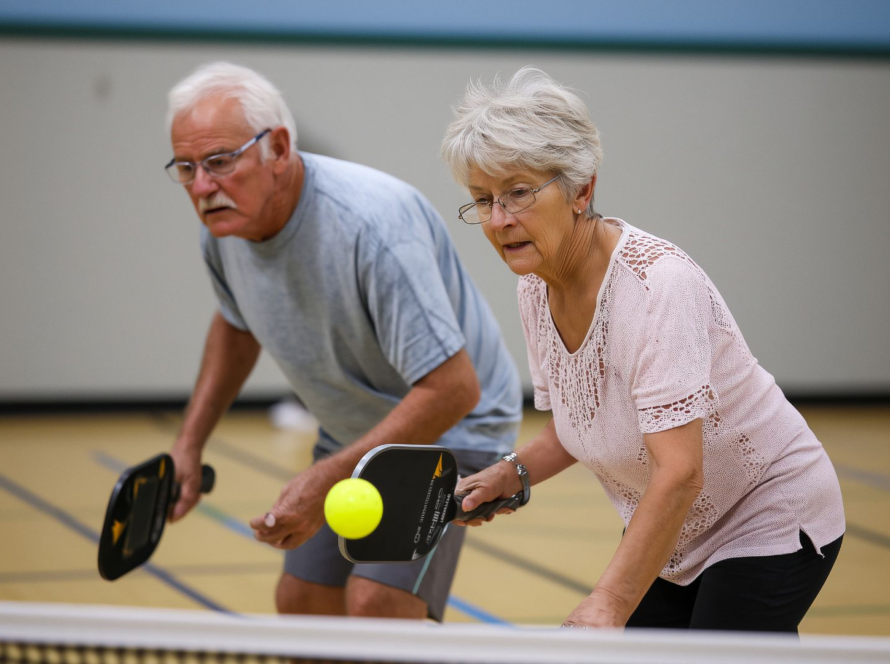
If you’re 55+ and love pickleball, your shoes are the most important piece of safety equipment after your paddle. The right pair can reduce knee and foot pain, prevent slips, and help you move with confidence on indoor and outdoor courts.
In this guide, we break down the best pickleball shoes for seniors based on stability, cushioning, width, and ease of use. Every recommendation is vetted against manufacturer specs, podiatry guidance, and first-hand play tests—so you can choose smart and play longer with less pain.
Whether you’re just starting or you’ve played for years, use this as your shortcut to the safest, most comfortable court-shoe setup for older players.

How to choose pickleball shoes for seniors: the 5 things that matter most
- Stability and ankle protection
- Look for sturdy sidewalls and a supportive midfoot (often called a “torsion” or TPU shank) to prevent rolling.
- Medial-lateral outriggers widen the base and add confidence during lateral shuffles.
- A snug heel that doesn’t slip is crucial for balance and fall prevention.
- Fit: width and volume (not just length)
- Most seniors need more toe room as arches change over time. Prioritize a wide toe box and enough depth for orthotics.
- A slightly longer shoe is safer than a cramped fit—black toenails usually mean the shoe is too short.
- Cushioning and “drop”
- Softer midsoles protect arthritic knees; many seniors feel best in 4–10 mm heel-to-toe drop.
- Higher drop (10–12 mm) unloads the Achilles; zero-drop encourages calf activation. Choose what feels best for your body.
- Traction and outsole durability
- All-court herringbone patterns work for most pickleball surfaces.
- Premium rubbers like NDurance, Michelin, and Goodyear typically last 25–40% longer outdoors.
- Weight and fatigue
- Target shoe weight: up to 13 oz (men’s US 9) or 11 oz (women’s US 7). Lighter shoes reduce fatigue without sacrificing support if the midfoot is reinforced.
Quick glossary (in plain English)
- Pivot circle: a smooth disc under the ball of your foot that helps you turn without torquing your knee.
- 3/4-length shank: a firm plate under the arch that resists twisting—great if you’ve had midfoot sprains.
- Outrigger: a flared base that adds side-to-side stability.
The best pickleball shoes for seniors (by need)
These are standout picks for older players based on fit, stability, cushioning, and ease of use. Choose the category that matches your priority.
Best overall stability and motion control: New Balance 806v1 (Men & Women)
- Why seniors like it: APMA-accepted stability shoe with ROLLBAR posting to limit rear-foot motion—excellent for over-pronation and balance issues.
- Comfort tech: ABZORB cushioning plus a supportive full-grain leather upper that breaks in without stretching out.
- Fit notes: Rare width options (men’s 2E and 4E, women’s D) and deeper volume for orthotics.
- Best for: Players who want a planted, confidence-inspiring ride.
- MSRP: $114.99
Best lightweight cushion for sore knees: New Balance FuelCell 996v5
- Why seniors like it: A softer, bouncier FuelCell midsole eases knee OA discomfort without feeling mushy.
- Durability: NDurance outsole warranty for high-wear players.
- Weight: About 11.6 oz (men) / 9.8 oz (women)—light for a stable court shoe.
- Fit notes: Standard and wide widths; good depth if you remove the stock insole for custom orthotics.
Widest toe box with zero break-in: Babolat SFX3
- Why seniors like it: The roomiest mainstream toe box—great for bunions and swelling.
- Comfort tech: Kompressor System heel pad for shock absorption; Michelin rubber for outdoor durability.
- Fit notes: Runs generous in the forefoot; true-to-size length.
Easiest on/off for stiff hands or limited hip flexion: NikeCourt Air Zoom Vapor 11 HC
- Why seniors like it: A half-bootie design and rear pull tab make entry simple if you struggle with dexterity.
- Court feel: Zoom Air forefoot unit adds spring; medial drag protection for toe-draggers.
- Traction: True hard-court herringbone that works on most pickleball surfaces.
Lockdown heel and torsion stability: Adidas Barricade 13
- Why seniors like it: Geofit pods hug the heel to reduce slippage (a common fall risk).
- Support: 3/4-length torsion system feels planted on hard cuts; Bounce 2.0 midsole is softer than past Barricades.
- Best for: Players who prioritize ankle confidence but still want cushioning.
Relief for plantar fasciitis or heel pain: ASICS Gel-Resolution 9 and New Balance 806v1
- Why seniors like it: Both offer stiff heel counters for control; forefoot rocker profiles help offload the plantar fascia.
- Tip: Add an aftermarket insole (PowerStep Pinnacle or Superfeet Green) if you need more arch support.
For diabetic feet, neuropathy, or extra-depth needs: Orthofeet Coral (Women) / Sprint (Men)
- Why seniors like it: Podiatrist-approved stretch-knit uppers with seam-free interiors and hidden depth for full-length orthotics.
- Traction: Slip-resistant rubber tested on smooth courts.
- Important: Best for low-level recreational indoor play—not a traditional performance court shoe.
Natural foot shape and zero-drop (coming soon): Altra Volley IQ
- Why seniors like it: A true zero-drop court shoe with a foot-shaped last; early testers report less forefoot numbness for Morton’s neuroma.
- ETA: Expected Summer 2025. If you’re curious about zero-drop, ease in gradually to avoid calf/Achilles flare-ups.
Fit and sizing checklist for older players
- Measure at day’s end when your feet are largest; re-measure every two years. Arch collapse can add up to half a size.
- Aim for a thumb-width of space in front of your longest toe. Black toenails usually mean the shoe is too short.
- Heel fit: Your heel should sit about 1/8–1/4 inch below the collar line. Too deep → Achilles rub. Too shallow → heel slip.
- Orthotics: Remove the factory insole and check depth. You shouldn’t feel the upper pressing on your toes.
- Lacing tweaks:
- Runner’s loop (heel-lock) for narrow heels or slippage.
- Box lacing to reduce pressure on arthritic big-toe joints.
- Weight target: Up to 13 oz (men 9 US) or 11 oz (women 7 US) balances cushioning and fatigue reduction.
- Bring your socks, orthotics, and ankle brace to the store; fit everything together.
Indoor vs outdoor pickleball soles: pick the right tread
- Indoor (urethane or wood):
- Non-marking gum rubber
- Tight herringbone
- Helpful: a pivot circle for smooth spins (less knee torque)
- Outdoor (asphalt or textured concrete):
- Wider herringbone or zig-zag patterns
- Harder rubber compounds with deeper flex grooves for longevity
- Good all-court compromises: Skechers Viper Court Elite, SQAIRZ XRZ (if you split time 50/50)
Common foot issues in seniors—and shoe solutions
- Plantar fasciitis: Look for stiff heel counters and mild forefoot rocker. Top picks: ASICS Gel-Resolution 9, New Balance 806 (+ supportive insole).
- Hallux rigidus (stiff big toe): Shoes with a wishbone TPU plate or a full-length carbon insert keep the toe from over-bending. Try Diadem Court Burst + a Carbitex plate.
- Bunions: Stretch-knit uppers and wide toe boxes relieve pressure. Try Babolat SFX3 or FitVille Rebound Core.
- Neuropathy: Seam-free interiors, extra depth, and gentle cushioning help. Orthofeet is a safe bet for light indoor play.
- Knee osteoarthritis: Softer, energetic midsoles reduce joint load. New Balance FuelCell 996v5 and Skechers EcoFlight are standouts.
When to replace your pickleball shoes
- Outsole: Bald spots wider than a dime indicate traction loss.
- Midsole: Compression wrinkles that don’t rebound mean cushion is “dead.”
- Sidewalls: If the shoe folds side-to-side in your hands, stability is gone.
- Typical lifespan:
- Indoor play: 60–80 hours
- Outdoor play: 40–60 hours
- Pro tip: Rotate two pairs. Letting midsoles “re-foam” for 24 hours doubles usable life and keeps joints happier.
What to expect by price tier (2025)
- Budget (≤ $90): Value-focused options like FitVille Wide, Wilson Pickle Pro, Adidas GameCourt 3, Orthofeet with coupon codes. Best for casual play and testing widths.
- Mid ($90–$130): Sweet spot for seniors—New Balance 806, FuelCell 996v5, Babolat SFX3, K-Swiss Supreme, Diadora Blushield 5 AG.
- Premium ($130–$160): More tech and support—SQAIRZ XRZ, ASICS Gel-Resolution 9, Diadem Court Burst, Adidas Barricade 13, Skechers Viper Court.
- Flagship ($160+): Top-tier foams and chassis—Salming Rebel Aero Court, Yonex Power Cushion Eclipsion 5, and the upcoming Altra Volley IQ.
Smart add-ons that make a big difference
- Insoles: PowerStep Pinnacle, Superfeet Green, or Currex AcePro can fine-tune arch height and heel control.
- Socks: Balega Blister-Resist or Thorlo Pickleball add 1–2 mm of cushion and cut in-shoe slippage.
- Ankle braces: If you wear one (EVS AS6, Zamst A2-DX), upsize your shoe by half to fit the brace.
- Easy-on accessories: A 24-inch metal shoe horn and elastic no-tie laces (like Hickies) make entry painless.
Quick decision guide (pick your priority)
- Need a wide forefoot: Babolat SFX3, K-Swiss Supreme, FitVille
- Bad ankles or prior sprains: SQAIRZ XRZ, Yonex Eclipsion 5, DAPS Mid
- Plantar fasciitis: ASICS Gel-Resolution 9 or New Balance 806 + supportive insole
- Mostly outdoor play in heat: Babolat Jet Mach 3, Skechers Viper Court (vent ports)
- Orthotics + depth: Orthofeet, New Balance 806, New Balance FuelCell 996v5
- Trouble tying laces: Nike Vapor 11 (pull tab) or add elastic no-tie laces
- Tight budget: Wilson Pickle Pro under $100, still non-marking
FAQ: pickleball shoes for seniors
Q1: Can I play pickleball in running shoes?
A: You can, but it’s not ideal. Running shoes are built for straight-ahead motion and have softer, higher midsoles that can wobble in quick lateral moves—raising ankle-sprain risk. Court shoes are lower, wider, and more stable side-to-side.
Q2: What drop is best for seniors?
A: Most older players do well in 4–10 mm drop. Higher (10–12 mm) can unload the Achilles; lower or zero-drop activates calves more. If you switch to lower drop, ramp down gradually to avoid calf or Achilles irritation.
Q3: How tight should my court shoes feel?
A: Snug in the heel and midfoot, roomy in the toes. You want a thumb-width of space at the front and no heel lift when you stop or shuffle.
Q4: How often should I replace my pickleball shoes?
A: Track play hours. Expect 40–60 hours outdoors and 60–80 hours indoors. When traction smooths, midsoles crease and don’t rebound, or sidewalls get floppy, it’s time.
Q5: Are wide sizes available in real court shoes?
A: Yes. New Balance leads with the 806 (2E/4E for men, D for women) and 996v5 (wide options). Babolat SFX3 also fits generous through the forefoot.
Conclusion
Bring your playing socks, any orthotics, and your ankle brace to try-on.
Use the fit checklist, pick the right outsole for your court, and rotate two pairs to protect your joints. Lace up, feel the difference, and play more confidently—today and five years from now.